
What Actually Happens During a Clinical Trial Visit? A Step-by-Step Patient Guide
Key Takeaways
- A clinical trial visit is a medical appointment that combines lab work, vital signs, and a physician check-in, plus study questionnaires.
- Joining a clinical trial starts with a 15–20 minute phone pre-screen, then a 2–3 hour screening visit with an exam, blood work, and informed consent, where the study's procedures, risks, and benefits are explained before enrolling (NIH, 2025).
- Clinical trial eligibility results usually come back within one to two weeks of the screening visit.
- Clinical trial visits typically start weekly, then move to monthly and later every few months, with compensation at each visit.
- Patients visiting Mission Research Institute in Gilbert, AZ, should bring a medication list, an insurance card, and written questions, and may bring a family member or friend.
One of the biggest barriers to clinical trial participation is simply not knowing what to expect. Patients imagine something clinical and impersonal — a maze of equipment, unfamiliar faces, and unclear instructions. The reality at a community-based research site like Mission Research Institute is quite different.
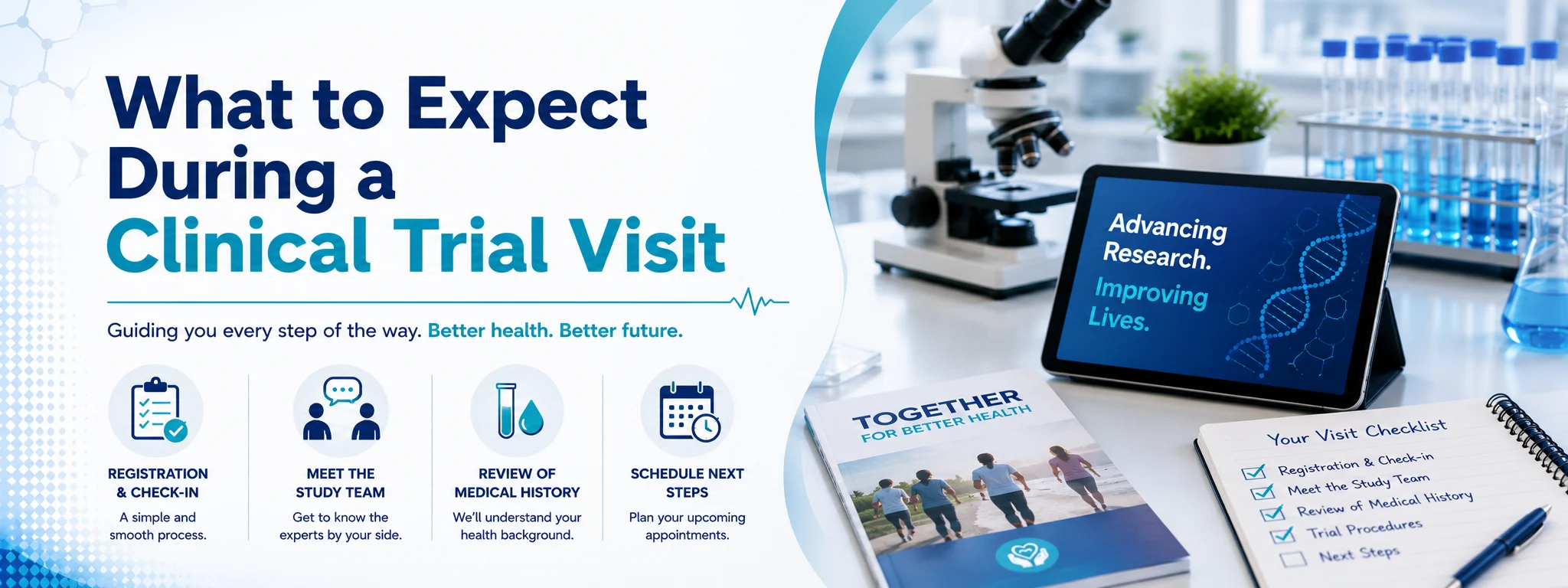
Here is a realistic, step-by-step picture of what a clinical research visit actually looks like — from your first phone call through study completion.
Step 1: The Phone Pre-Screen (15–20 Minutes)
It starts with a conversation, not a form. A research coordinator calls you — or you call us — and asks a series of brief questions about your health history, current medications, diagnoses, and general lifestyle. This is not a medical evaluation. It is simply a first filter to determine whether a particular study might be a good fit based on its eligibility criteria.
If you pass the pre-screen, the next step is scheduled: a free on-site screening visit.
Step 2: The Screening Visit (2–3 Hours)
- A review of your medical history and current medication list
- Vital signs: blood pressure, heart rate, weight, height
- Physical examination performed by a study physician
- Blood draw for laboratory evaluation (metabolic panel, lipids, HbA1c, and study-specific markers)
- An EKG in some studies
- A review and signature of the Informed Consent Form — with as much time as you need to ask questions
Step 3: Waiting for Results and the Eligibility Decision
Step 4: The Baseline and First Treatment Visit
Step 5: Follow-Up Visits — The Rhythm of the Study
Step 6: Study Completion and End-of-Study Visit
What to Bring to Your First Research Visit
- A complete list of all medications, supplements, and vitamins with dosages
- Your insurance card — though study-related care will not be billed to insurance
- Reading glasses if you need them for reviewing documents
- A trusted family member or friend if you would like support
- Questions written down — there are no wrong ones